
Table of Contents
The Best Mentor You’ll Ever Meet Might Never Tell You What to Do.
In fact, if your mentors are giving you all the answers, they may not be mentoring you at all. So, how to choose a Mentor the right way?
Every year on Guru Purnima, social media fills with heartfelt messages thanking teachers, mentors, and guides who have influenced our lives. We post photographs, write emotional captions, and express our gratitude. But amidst all the celebrations, I often find myself thinking about a different question.
What actually makes someone a good mentor?
Is it their years of experience?
Their designation?
Their achievements?
Or simply the fact that they are older than us?
After mentoring students, interacting with young professionals, working with entrepreneurs, and teaching in higher education for years, I have realised something that may sound counterintuitive.
The best mentors rarely give you ready-made answers or spoon feed you with the direct answers. Instead, they help you reflect through by asking questions that shape your thinking and help you discover answers yourself.
Think about it like this. Whenever we face a career dilemma, we usually expect someone to tell us what to do and answer questions like:
“Which specialization should I choose?”
“Should I prepare for government jobs or pursue higher education?”
“Should I join a startup or a multinational company?”
“Should I leave my stable job and start my own venture?”
Most people search for advice.
But exceptional mentors, rather than giving advice, will ask you questions that sharpen your thinking. Therefore, rather than saying, “Here’s what you should do,” they often ask,
“Why do you think this is the right choice?”
“What assumptions are you making?”
“What evidence supports your decision?”
“What are you trying to capitalize on – is it your salary, learning, purpose, or security?”
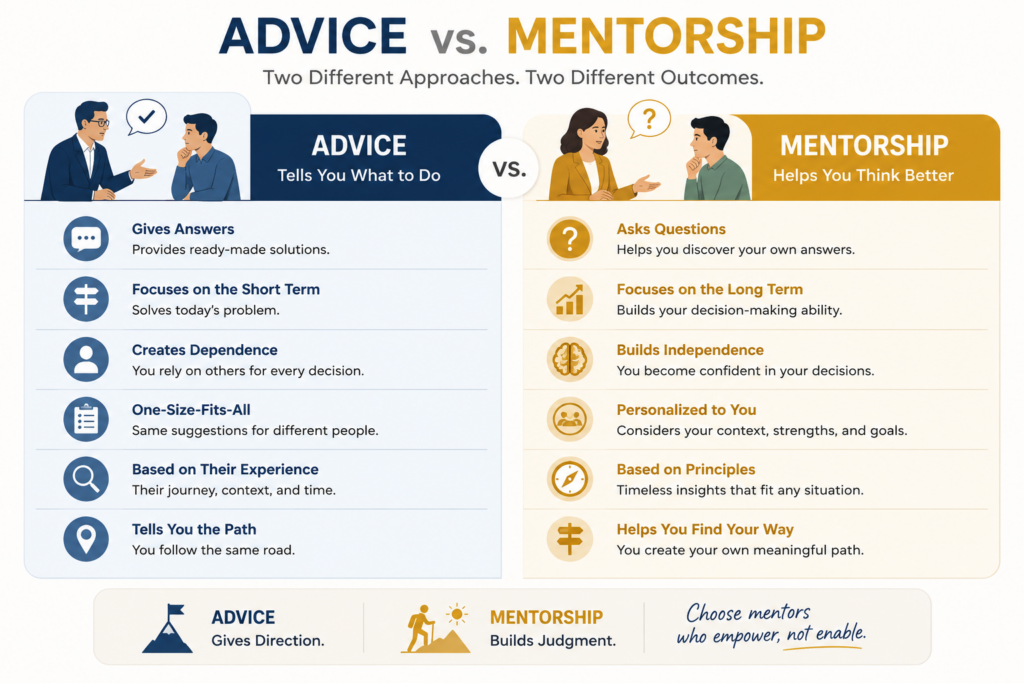
While these questions may not provide you with immediate answers, they provide you with something much more valuable.
Clarity
And clarity often lasts much longer than a simple advice.
Therefore, it becomes important to understand that your mentor’s successful career journey happened in a different context, at a different time, with different opportunities and constraints. Trying to copy their path without understanding your own context can become one of the biggest career mistakes.
And this is why the career development should never be about collecting opinions or simply taking advice. It should be rather about developing the ability to make better decisions.
In this reference, a mentor’s role is not to make decisions for you but to improve your decision-making. This is where you need to carefully consider the below given 4M framework while choosing a right mentor for you.
The 4M Framework: How to Choose a Mentor
If you’re a student, young professional, entrepreneur, or even someone considering a career transition, here’s a simple framework that can help you evaluate whether someone is truly helping you grow.
M1 – Mindset
The first responsibility of a mentor is not to teach you what to think. It is to challenge how you think. Therefore, while evaluating whether someone is truly helping you grow, consider reflecting on below given questions:
Do they encourage you to question your assumptions?
Do they expose you to perspectives that make you uncomfortable in a constructive way?
Do conversations with them leave you thinking long after they end?
A mentor who expands your thinking prepares you for challenges that don’t even exist yet. So, ask yourself:
“Does this mentor challenge my assumptions, or simply confirm what I already believe?”
M2 – Mastery
Degrees may open doors; Skills help you stay inside. That’s why, the best mentors don’t obsess over your marks, certificates, or job titles. Instead, they consistently redirect your attention towards capability. They help you ask,
“What can I do today that I couldn’t do six months ago?”
Whether it’s communication, analytical thinking, leadership, problem-solving, negotiation, or opportunity recognition, mentors who focus on mastery prepare you for careers that evolve with changing industries. So, ask yourself:
“Am I becoming more capable after every interaction?”
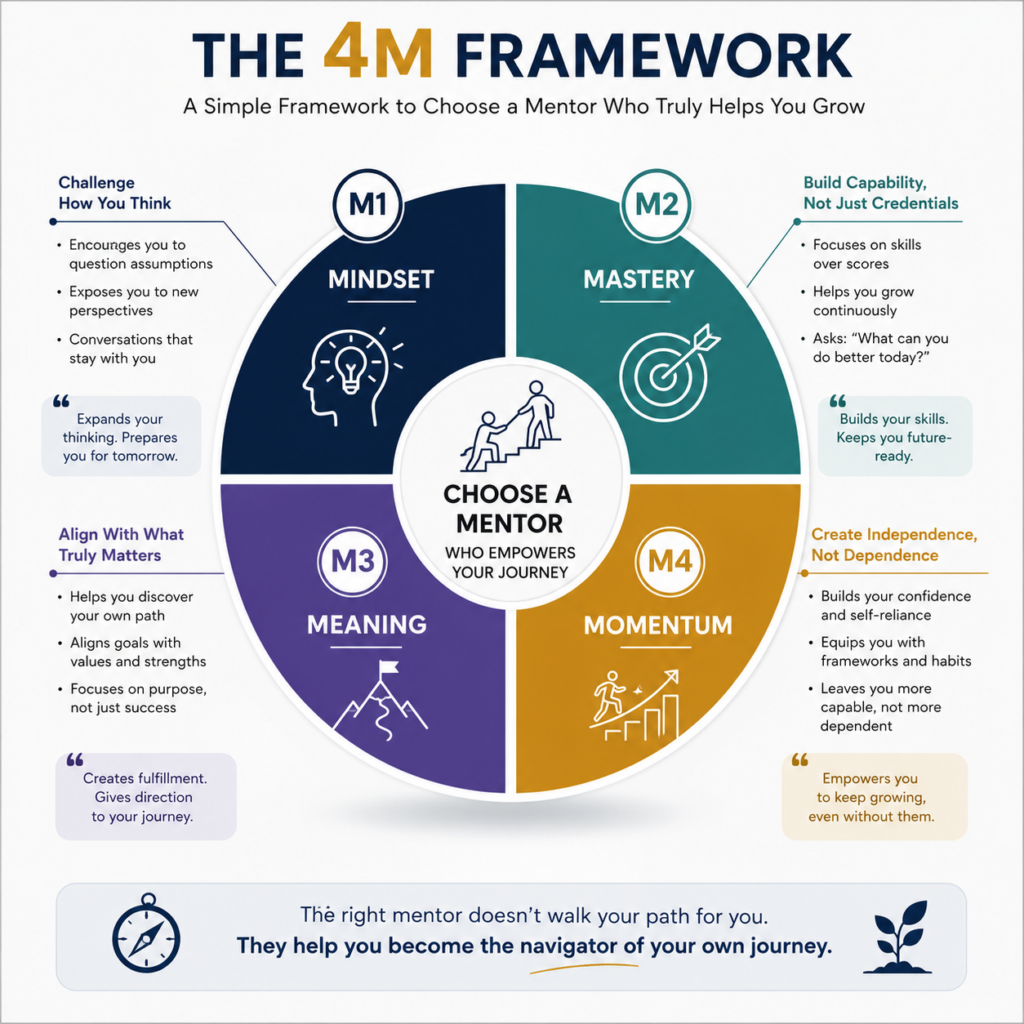
M3 – Meaning
Success looks different for different people. Unfortunately, many individuals spend years pursuing goals that were never truly theirs.
Some chase prestige.
Some chase salaries.
Some chase expectations.
But only a few pause to ask whether the destination actually aligns with their values, strengths, and aspirations. That’s where, the best mentors help you distinguish between external success and internal fulfilment.
They don’t ask, “What is everyone else doing?”
Instead, they ask, “What kind of life are you trying to build?”
So, ask yourself:
“Is this mentor helping me discover my own path rather than encouraging me to imitate someone else’s?”
M4 – Momentum
Perhaps the greatest test of mentorship is this:
Does the mentor create dependence, or independence?
Some people make themselves indispensable.
Great mentors do the opposite.
They equip you with the confidence, frameworks, and habits needed to continue growing even when they are not around.
After every meaningful interaction, you shouldn’t feel more dependent.
You should feel more capable.
Because the purpose of mentorship is not lifelong dependency.
It is lifelong learning.
So, ask yourself:
“Am I becoming more confident in making decisions independently?”
So, as you reflect on this 4M framework today to choose the right mentor to help you fulfil your career aspirations, there is another thought worth considering.
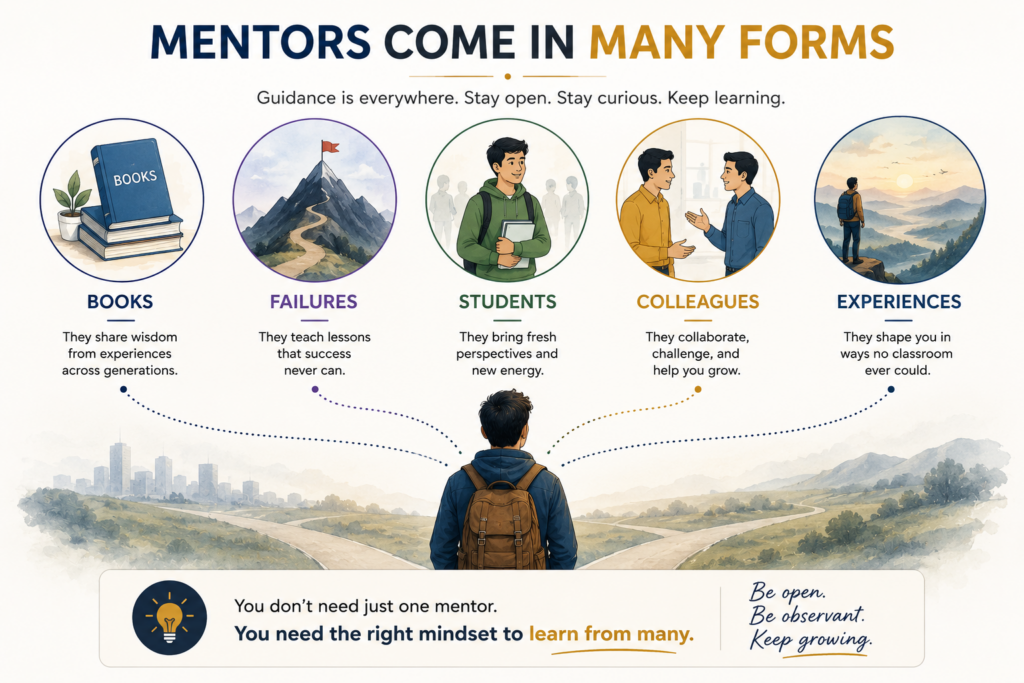
The most valuable mentor in your life may not always be the one standing in front of a classroom or sitting across a meeting table.
Sometimes, it is a book that changes the way you think.
Sometimes, it is a colleague who asks an uncomfortable question.
Sometimes, it is a failure that forces you to grow.
Sometimes, it is a student whose curiosity challenges your own assumptions.
Learning doesn’t always arrive wearing the title of “mentor.”
It often arrives disguised as an experience.
The real skill is recognizing it.
So, instead of asking,
“Who is the most successful person I can learn from?”
Perhaps ask,
“Who consistently helps me think more clearly, act more confidently, and become more capable?”
Because careers are rarely transformed by direct answers.
They are transformed by a series of better questions.
And the people who teach us to ask those questions become our true mentors.

On this Guru Purnima, let’s celebrate not only the teachers who shared knowledge, but also the mentors who shaped our thinking, challenged our assumptions, and quietly prepared us for decisions they knew they would never make on our behalf.
Their greatest gift was never an answer.
It was helping us think independently.
And perhaps that is the highest form of mentorship.
Now, I would love to hear your story.
Think about one person or one book or one experience that has genuinely influenced your journey not by solving your problems, but by changing the way you think.
Share your answers in the comment and mention them. Your story might become the encouragement someone else needs today. Also, if this article resonated with you, consider sharing it with your students, colleagues, friends, or anyone passing through important career decisions. Sometimes, asking someone the right questions can be far more valuable than giving them another answer.
Disclaimer: The views presented in this article are the author’s own views. The views are presented here just for the purpose of information. These views are not meant to harm any one’s belief / thoughts.

Mr. Raunak Gupta is a lifelong learner, keen Academician, enthusiastic communicator and MiDNA certified Genetic Brain Profiling Consultant. He finds true happiness in helping the individuals to identify their core strengths and realizing true potential for a blessed & cheerful journey of life.