
Table of Contents
How to Evaluate a Business Idea Before Starting a Startup?
Before investing in an idea, invest in becoming the kind of founder who can build it (Founder–Idea Fit)
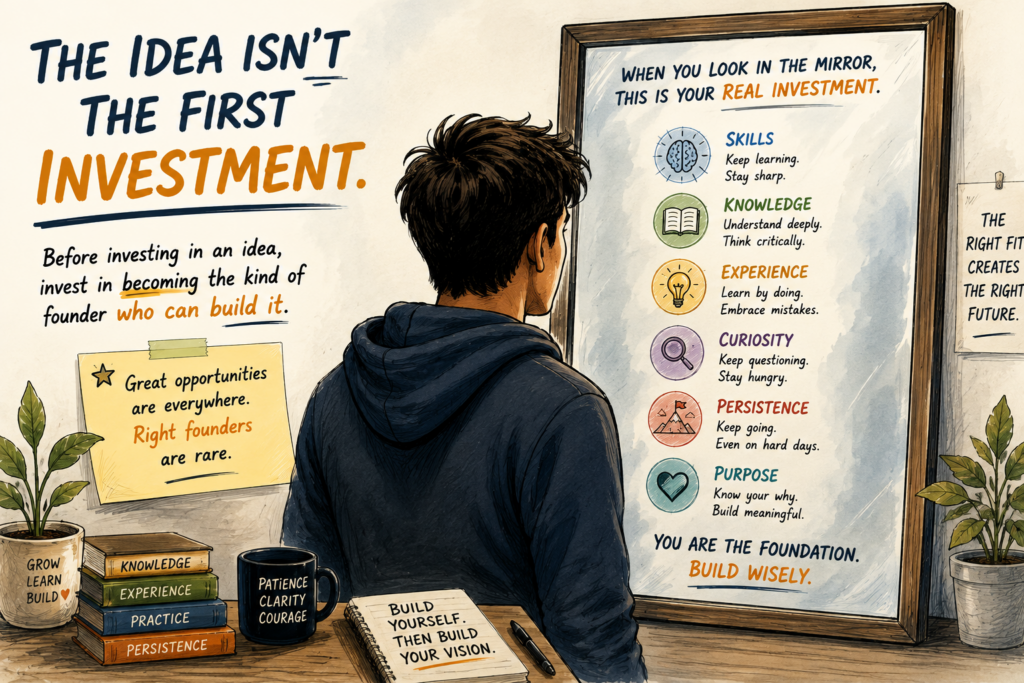
“Should I start this business?”
It is probably the most common question I hear from students, aspiring entrepreneurs, and even working professionals.
Interestingly, very few of them ask,
“Am I the right person to build this business?”
That one question changes everything.
Over the years, I have interacted with thousands of students, mentored aspiring entrepreneurs, and worked closely with startups at different stages. One pattern appears repeatedly.
People spend months polishing their business idea.
Very few spend even one hour evaluating whether they are actually a good fit for that idea.
And that’s where many entrepreneurial journeys quietly fail, not because the idea was bad, but because the founder and the idea were never meant for each other.
The Biggest Myth About Entrepreneurship
Popular culture has convinced us that entrepreneurship is all about finding a “million-dollar idea.”
Movies celebrate breakthrough inventions.
Social media glorifies unicorn founders.
News headlines highlight revolutionary startups.
But if you observe carefully, successful entrepreneurs rarely start because they discovered a magical idea.
Instead, they identify opportunities that match three things:
who they are,
what they understand,
and what they are willing to commit to for years.
An average idea pursued by the right founder often performs far better than a brilliant idea pursued by the wrong founder.
Before writing a business plan, creating a logo, or registering a company, ask a much simpler question:
“Am I genuinely built to solve this problem?”
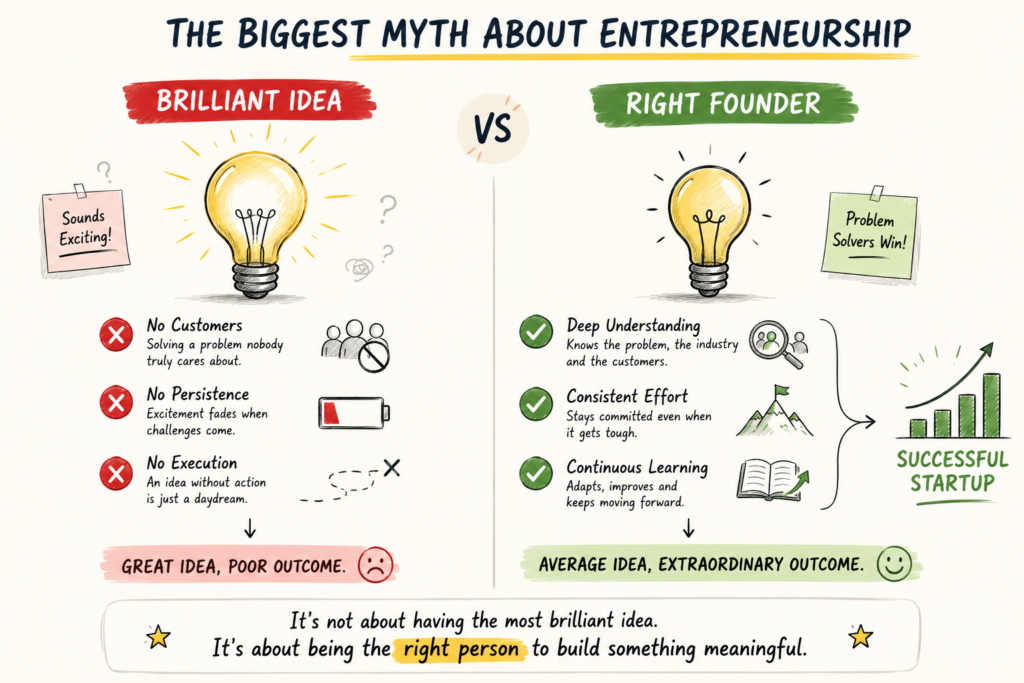
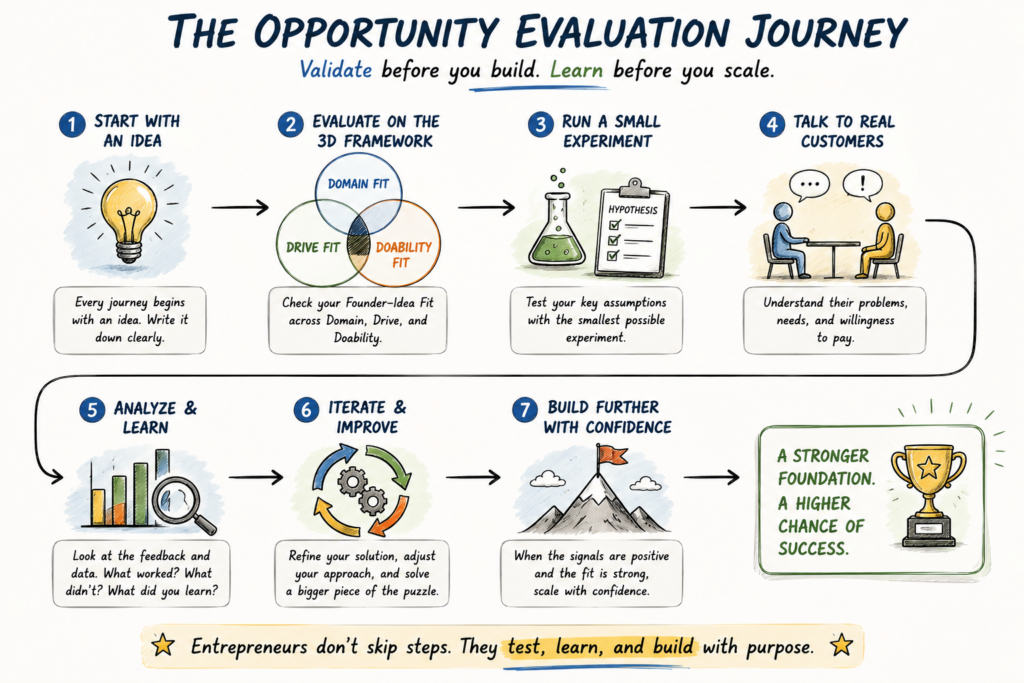
To answer that, I use a simple 3D Framework.
The 3D Framework for Evaluating an Opportunity
Think of every business opportunity through three lenses.
Dimension 1: Domain Fit
Do I understand this world well enough?
Every business exists inside a domain.
Healthcare.
Education.
Agriculture.
Fashion.
Technology.
Food.
Finance.
Many beginners confuse interest with understanding.
Watching Shark Tank doesn’t mean you understand retail.
Using AI tools doesn’t mean you’re ready to build an AI startup.
Ask yourself:
Do I understand how this industry works?
Have I interacted with its customers?
Do I know the common problems people face?
Can I explain the industry to someone else?
For example: Imagine two founders wanting to start an online tutoring platform. The first founder has spent eight years teaching students, interacting with parents, and understanding learning challenges. The second founder simply thinks, “EdTech is growing.” Both may have similar technical skills. But the first founder has something much more valuable, context. That context helps in making better decisions, designing better services, and avoiding beginner mistakes.
You don’t always need years of experience.
But you do need enough exposure to understand the problem deeply.
Dimension 2: Drive Fit
Will I still enjoy solving this problem after the excitement disappears?
Every startup looks exciting in the beginning.
Building the website is exciting.
Choosing a company name is exciting.
Designing a logo is exciting.
Reality begins when customers don’t respond.
When sales don’t happen.
When investors reject you.
When your product needs to change again.
The real question is not,
“Am I excited today?”
It is,
“Will I still be willing to solve this problem two years from now?”
For example: A student once wanted to build a fitness startup because “health is trending.” When we discussed further, it turned out he didn’t enjoy talking about fitness, reading about health, or helping people improve their lifestyle. He simply saw a market opportunity. That motivation rarely survives difficult days. Now compare this with someone who spends weekends experimenting with nutrition, reading research, helping friends build workout plans, and discussing healthy habits without being paid. Guess who is more likely to persist?
Entrepreneurship rewards sustained curiosity more than temporary excitement.
Dimension 3: Doability Fit
Can I realistically build this with the resources I have today?
This is where many first-time founders become overambitious.
Someone wants to compete with Amazon.
Another wants to build “the next Uber.”
A student wants to create India’s biggest AI company before even speaking to one customer.
Ambition is good.
Ignoring reality isn’t.
Ask yourself:
Do I possess the required skills?
Can I learn the missing ones?
Do I have access to the right people?
Can I build a small version first?
What is the cheapest experiment I can run this month?
Remember,
You don’t need enough resources to build the final company.
You only need enough resources to validate the first assumption.
For example: Suppose someone wants to build an AI-powered career guidance platform. Instead of investing lakhs into software development, they could begin by manually conducting career consultations, understanding student challenges, testing AI-assisted recommendations, and validating whether people actually find value. The learning generated from these early experiments is often worth far more than the first version of the product.
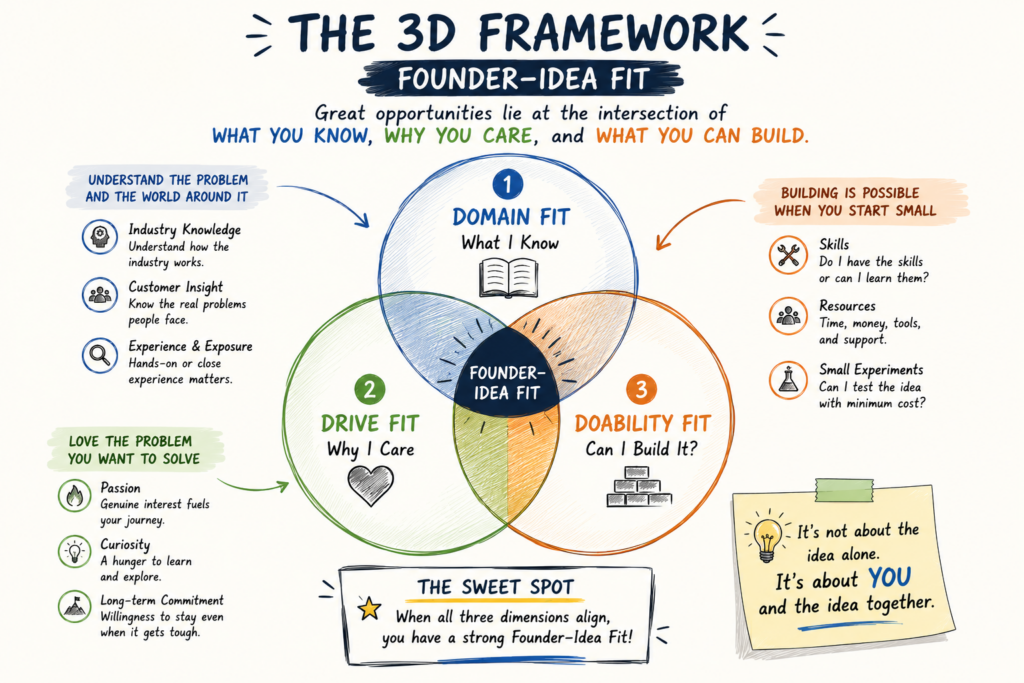
When All Three Dimensions Meet
Imagine these three dimensions as overlapping circles.
The best opportunities lie where all three intersect.
You understand the domain.
You genuinely enjoy solving the problem.
You can realistically take the first few steps.
That doesn’t guarantee success.
But it significantly increases your probability of staying long enough to succeed.
A Quick Self-Test to check Founder–Idea Fit
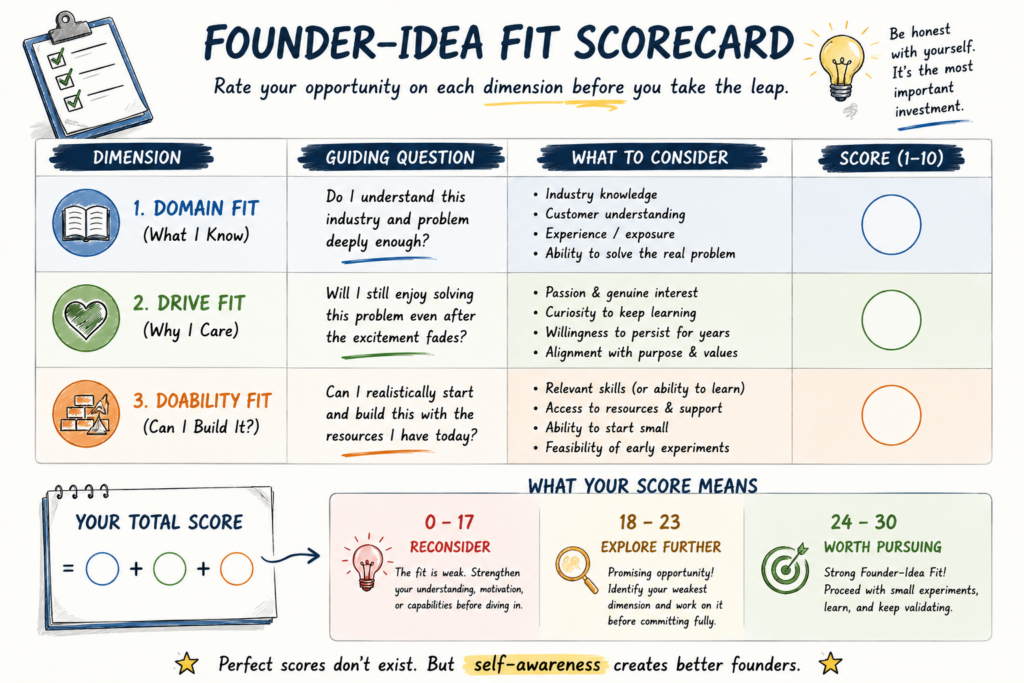
Before pursuing any business idea, rate yourself on each dimension from 1 to 10.
Domain Fit: How well do I understand this problem and industry?
Drive Fit: How committed am I to solving this problem for the next three to five years?
Doability Fit: Can I realistically begin solving this problem with my current resources?
Now total your score.
24–30: Strong Founder–Idea Fit. Worth exploring seriously.
18–23: Promising, but identify the weakest dimension and strengthen it before committing.
Below 18: Don’t abandon the idea immediately, but don’t rush into execution either. First, improve your understanding, motivation, or capability.
This isn’t a scientific assessment.
It’s a conversation starter with yourself to check the Founder–Idea Fit.
One Thing I Keep Observing
One of the privileges of working with students, entrepreneurs, and startups is watching how different journeys unfold.
The founders who make consistent progress are rarely the ones with the flashiest ideas.
They’re the ones who keep asking better questions.
Instead of saying,
“How can I become the next big startup?”
they ask,
“What problem am I genuinely equipped to solve?”
That shift changes everything.
Because entrepreneurship is not a competition to find the biggest idea.
It is a commitment to solving a meaningful problem, consistently, with the abilities, experiences, and determination you bring to the table.
Final Thought
The next time you get excited about a startup idea, resist the urge to jump straight into execution.
Pause for a few minutes.
Evaluate yourself before evaluating the market.
Because the first investment in any startup isn’t money.
It is the founder.
And before asking whether your idea deserves your time, ask whether you and your idea are truly the right fit for each other.
Disclaimer: The views presented in this article are the author’s own views. The views are presented here just for the purpose of information. These views are not meant to harm any one’s belief / thoughts.

Mr. Raunak Gupta is a lifelong learner, keen Academician, enthusiastic communicator and MiDNA certified Genetic Brain Profiling Consultant. He finds true happiness in helping the individuals to identify their core strengths and realizing true potential for a blessed & cheerful journey of life.